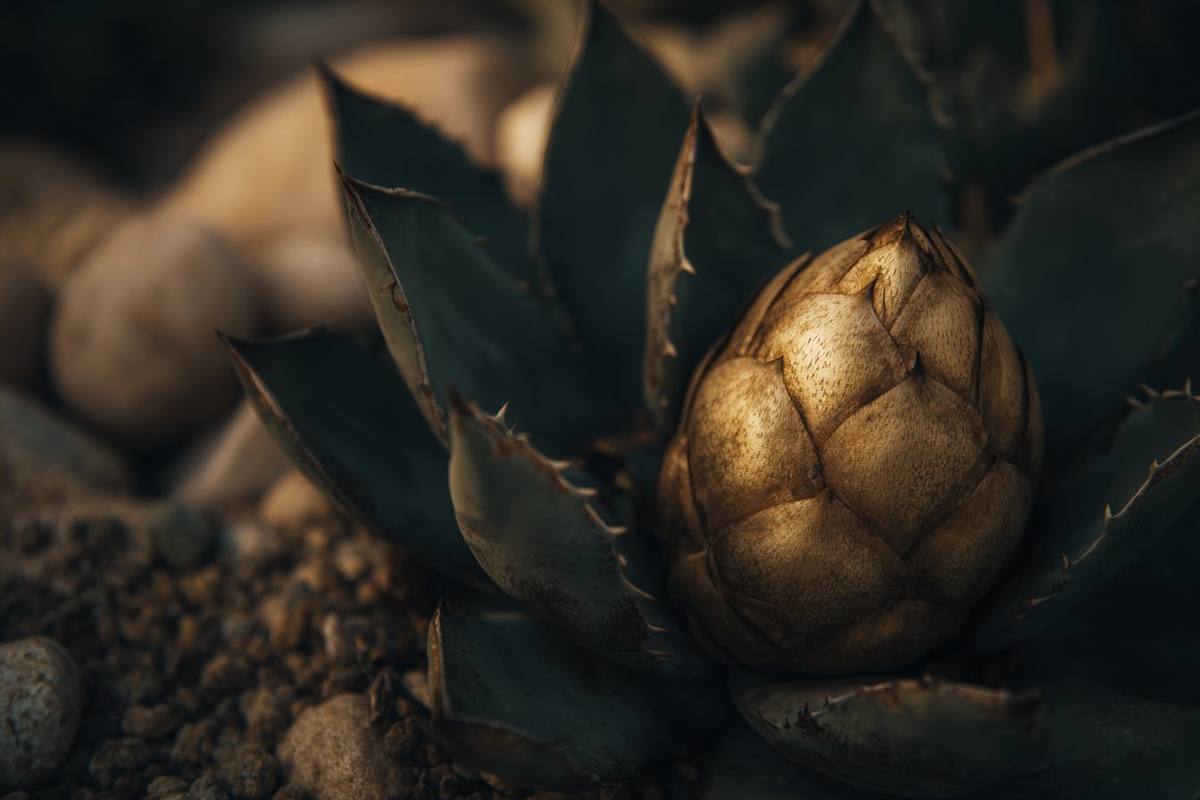
Capón means “castrated.” In mezcal production, it refers to an agave whose quiote — the flowering stalk — has been cut before the plant can bloom. It is a technique that transforms the spirit the plant produces.
The Quiote
When an agave reaches full maturity, it sends up a quiote: a tall flowering stalk that can grow several metres in a matter of weeks. The quiote is the plant’s final act — it channels all its stored energy into producing flowers and seeds, and then the plant dies. In agave terminology, this is its one reproductive event in a lifetime that may span decades.
The Cut
If the quiote is cut just as it begins to emerge, the plant survives — but it has nowhere to send its energy. The sugars and nutrients that would have fuelled the flowering stalk are redirected back into the piña, the heart of the plant. The piña swells. It becomes denser, sweeter, more concentrated. The plant may live for another year or two in this state, continuing to accumulate sugars with no reproductive outlet.
The result, when the plant is finally harvested and distilled, is a spirit with noticeably more depth, sweetness, and complexity than a standard espadín. Gota Gorda’s Espadín Capón demonstrates this beautifully: bitter chocolate, cooked agave, ripe plum — a richness that standard espadín rarely achieves.
Capón is not a gimmick. It is a technique that requires timing, knowledge, and patience. The jimador must recognise the moment the quiote begins to emerge and act quickly. Too early and the effect is minimal. Too late and the plant has already spent its energy.
Is Capón Better?
Different, rather than better. A capón espadín is richer and more concentrated. A standard espadín can be lighter, brighter, more approachable. Both have their place. But capón represents an extra investment of time, attention, and skill — and for Gota Gorda, it is the method Felipe Garcia chooses for his entry-level expression, which tells you something about the standard he sets across the range.