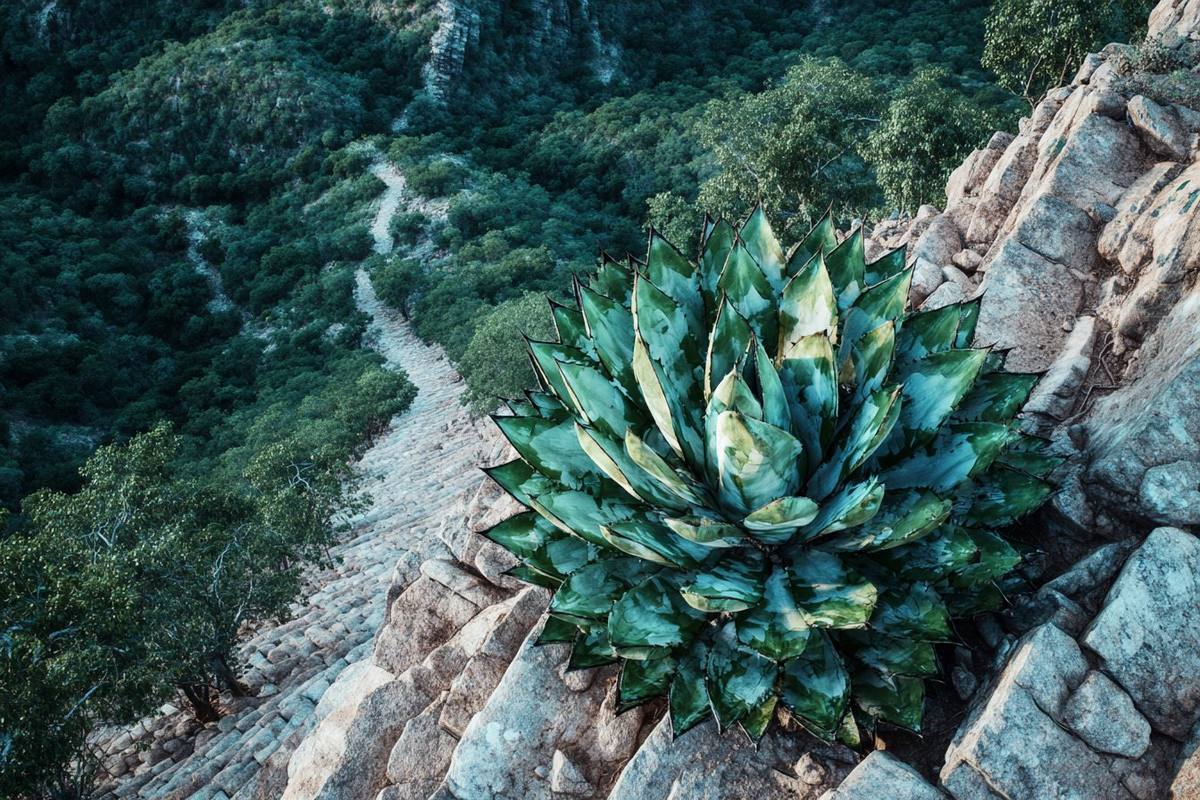
A bottle of tepextate mezcal represents a plant that may have been alive for a quarter of a century. It grew on a cliff face or a steep hillside. It was not planted by anyone. It could not have been — tepextate does not cooperate with cultivation. To make this spirit, someone had to walk the hills, find the plant, judge its maturity, and carry a 40-kilogram piña back down a mountain.
Why Wild Matters
Wild agave grows where it chooses. It competes for water, nutrients, and sunlight in harsh terrain. It develops slowly, concentrating its sugars over years or decades in response to environmental stress. By the time a wild tepextate reaches maturity, it has stored twenty-five years of the hillside’s mineral composition, rainfall patterns, and microbial environment in its piña. All of that becomes the spirit.
Cultivated espadín, by contrast, grows in prepared soil with adequate water, reaches maturity in six to eight years, and produces a more uniform — though still excellent — raw material. Wild agave is not “better” in some abstract sense. But it is different, and the difference is written into every sip.
The Scarcity Problem
Wild agave cannot be farmed. It can be encouraged — some mezcaleros scatter seeds or transplant young plants — but true wild agave populations depend on natural reproduction, which is itself threatened. An agave reproduces by sending up a quiote: a flowering stalk that can grow several metres tall. The quiote produces seeds, and then the plant dies. Every agave harvested for mezcal is an agave that never flowered, never seeded, never reproduced.
This creates an obvious tension. Growing demand for wild-agave mezcal puts pressure on populations that take decades to regenerate. Responsible producers — including Felipe Garcia, who produces Gota Gorda’s wild expressions — manage this by harvesting selectively, replanting where possible, and accepting small batch sizes as a natural consequence of doing things right.
Felipe Garcia’s Tebequil batch produced 30 litres. Twenty-three bottles for the UK. That is not a marketing strategy. It is ecology.
The Flavour of Time
What does twenty-five years of growth taste like? In tepextate: green coffee, dry grass, geranium, cedar, a long mineral finish. In jabalí: petrichor, wet leaves, red clay, tobacco. These are not flavours you find in cultivated agave. They are the flavours of stress, patience, and deep roots in difficult ground.
When you drink wild agave mezcal, you are drinking time. Not metaphorically. Literally. The sugars in the glass are the accumulated energy of decades. That is why these bottles cost what they do, and why they are worth it.